Markets, Rates, and Retirement: A Mid-Year Economic Check-In
Somewhere in your 401(k) or brokerage account right now, there’s probably more exposure to five or six tech names than you realize. Most people never go looking for that number until something rattles the market, and this year has given us plenty of rattling.
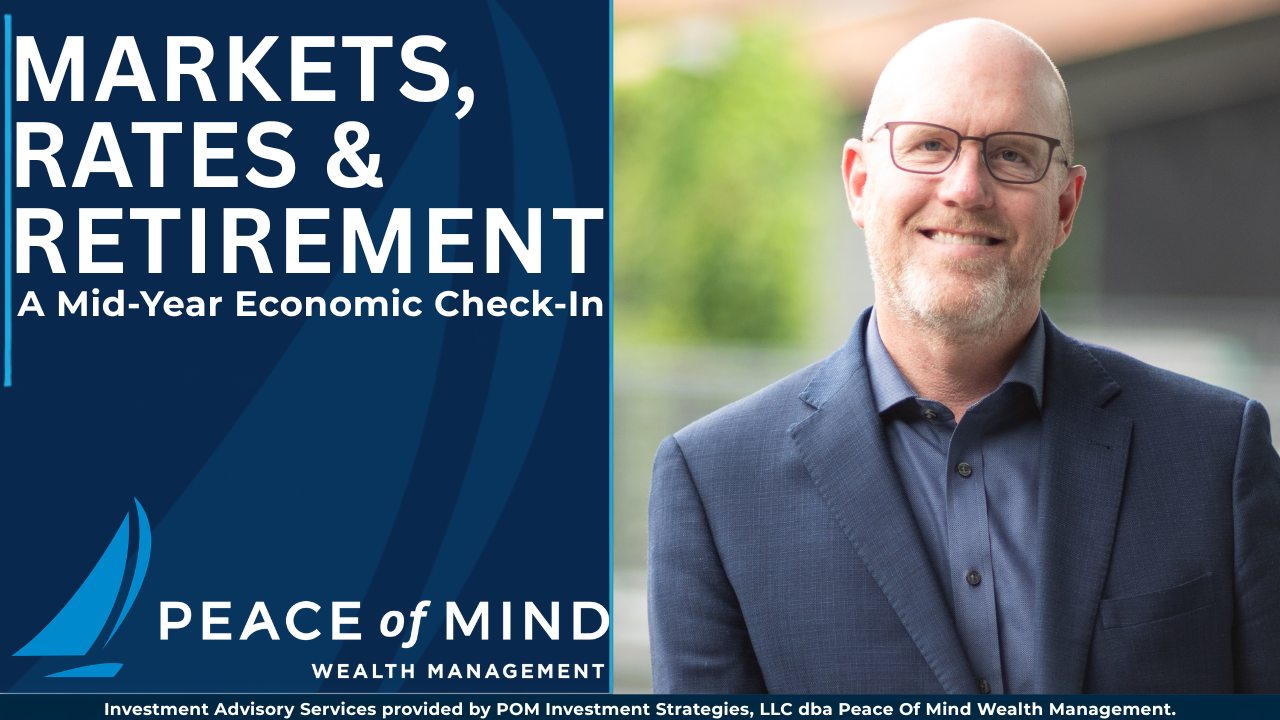
We asked Tom Siomades, chief market economist and a returning guest on Secure Your Retirement, to make sense of it for this week’s mid-year check in. Before we get into what he said, one important note: Tom is sharing his own professional opinion as an economist. This is not investment advice from Peace of Mind Wealth Management, and it isn’t a recommendation for your specific portfolio. What you do with it is a conversation for you and your own advisor.
A tale of two markets
Tom’s phrase for 2026 stuck with us: a tale of two markets. On one side, you’ve got AI and big tech, the names carrying most of the market’s gains this year. SpaceX just completed a heavily hyped IPO, and Tom expects Anthropic and OpenAI could follow later in the year. On the other side, you’ve got the rest of the market, which he described as “kind of holding water.” Consumer stress, inflation, and general economic uncertainty are weighing on everything outside the tech darlings.
That split matters more than it sounds like on the surface. When a small handful of companies is doing most of the heavy lifting for index returns, your overall portfolio return can look healthy on paper while masking real unevenness underneath. If your retirement savings are concentrated in a handful of large tech positions, whether through individual stock, employer stock, or a fund that’s quietly become tech heavy, your risk profile may be very different from what you think it is.
Don’t buy into the hype
On the SpaceX IPO specifically, Tom’s advice was blunt. Stay away from individual, hyped up names unless you deeply understand the business and you’re investing for the long term, not because a headline got you excited. His reasoning: these stocks tend to run up on hype, come back down, and the smarter entry point is often waiting for the pullback, if you believe in the company at all.
He drew the same line around Anthropic and the other AI companies likely to go public later this year. Wanting a company to succeed and it actually being a good investment for your specific goals are two different things, and Tom was candid that the market tends to be overly optimistic about these names until profitability gets tested in daylight.
Here’s the part that applies directly to retirement planning. These fast growing AI and infrastructure companies aren’t profitable today. Tom pointed out they’re borrowing heavily to fund data centers and infrastructure, betting on returns years down the road. That means they’re sensitive to interest rates in a way established, cash generating businesses aren’t. One week the story is “this changes everything,” the next it’s “infrastructure costs are exploding,” and the stock price yo-yos accordingly. That’s an exciting ride if you’re 35 and have decades to ride it out. It’s a different conversation entirely if you’re drawing income from that account in the next five to ten years.
Why “the market is up” doesn’t mean your plan is fine
The S&P has had a genuinely strong year, up somewhere in the 7 to 10 percent range even after absorbing the Iran conflict, oil price spikes, and Fed uncertainty. Tom’s honest reaction was that he’s a little surprised it’s up as much as it is. But an index number and your personal retirement plan are not the same thing, and this is where we see the most confusion.
If your portfolio happens to be overweight in the names driving that index higher, you may be showing a great year on paper while carrying more concentration risk than you’d choose deliberately. And if you’re the spouse who isn’t the one checking the account balance every week, often the case in the households we work with, you may have no idea that risk exists until a downturn makes it obvious the hard way.
This is exactly why a risk assessment shouldn’t be a one time event you did five years ago and forgot about. Life changes, markets change, and a portfolio that made sense when you were accumulating can be a mismatch for the income phase you’re actually in now.
Where the real lever is, and it isn’t stock picking
Tom’s outlook for the second half of 2026 was cautiously optimistic. He doesn’t think a recession is close, he sees a decent chance the S&P could add another 10 percent if inflation, oil, and the Iran situation resolve favorably, and he’s genuinely excited about the long term productivity gains AI could bring. Good news, with real caveats attached.
But here’s what we’d add, sitting on the planning side of this rather than the market commentary side. Whether tech stocks are up 20 percent or down 20 percent next year, the biggest lever most of our clients have isn’t picking the right stock. It’s what happens on the tax side. Required minimum distributions, Roth conversion windows, and coordinated tax filing rather than reacting every April, that’s where retirees consistently find more controllable value than trying to time an AI rally or a pullback.
At Peace of Mind Wealth Management, that’s the whole idea behind the Peace of Mind Pathway™. Your investment strategy gets built around your actual risk tolerance, not the excitement of the moment, and it sits inside a plan that also covers income, tax, estate, and healthcare under one team. One team, one plan, one fee, so a headline about SpaceX or Anthropic doesn’t need to become a stress event in your household.
A few questions worth asking yourself this week
If any of this sat with you, three questions are worth a few minutes of honest reflection.
- How much of your portfolio is actually concentrated in a handful of tech names, whether you meant it to be or not?
- Does your current advisor talk to you about tax strategy as often as they talk to you about performance?
- If your spouse had to explain the household investments to someone tomorrow, could they?
Want Tom’s full take, including his read on inflation, the new Fed chair, and the Iran conflict? Catch this week’s full episode of Secure Your Retirement. And if you’d like an honest look at how concentrated your own portfolio really is, head to pomwealth.net and schedule a conversation. If there’s nothing worth changing, we’ll tell you that too.
This article discusses the views of a third party guest, Tom Siomades, shared on the Secure Your Retirement podcast. It is intended for general informational purposes only and does not constitute individualized financial, tax, or investment advice. Please consult your own financial professional regarding your specific situation.