
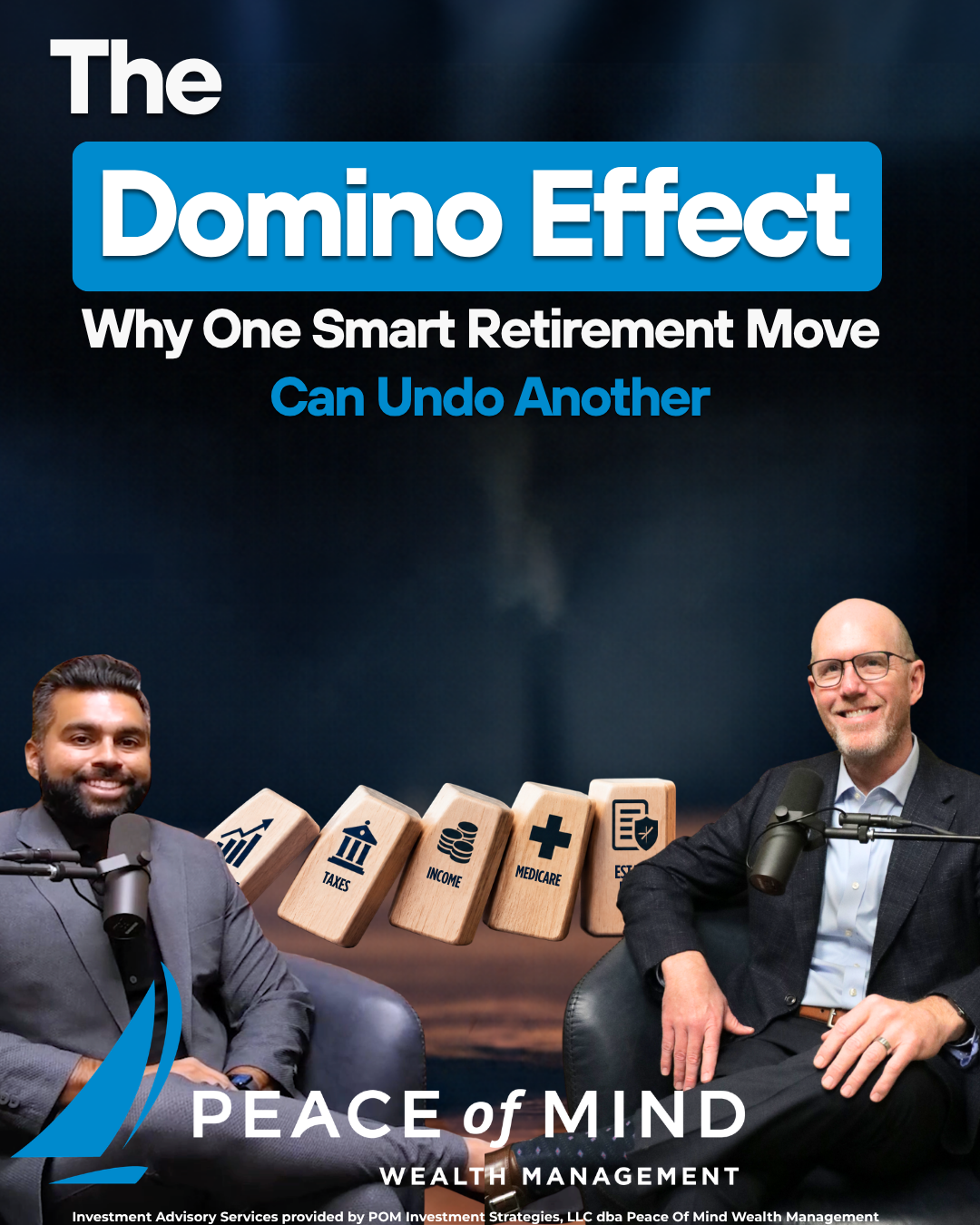
Episode 390
In this Episode of the Secure Your Retirement Podcast, Radon and Murs discuss the domino effect in retirement tax planning, where one smart move quietly knocks over another part of your plan. They walk through four cases from recent tax strategy meetings, including a guaranteed income annuity that would have cancelled a charitable tax break, a 0% capital gains sale that raised a couple’s tax on Social Security, and a high earner working out how to exit a variable annuity without stacking taxes on top of deferred compensation.
Listen in to learn about how Roth conversions, Social Security timing and Medicare IRMAA surcharges affect each other, why picking one dominant goal makes these decisions easier, and the seven year-end items to settle before December 31.
In this episode, find out:
- How a lifetime income annuity can cancel the tax benefit of a qualified charitable distribution
- Why a stock sale in the 0% capital gains bracket can still raise the tax on your Social Security
- How starting Social Security early can shrink the room you have for Roth conversions and move you closer to IRMAA
- What “valley years” are and how to use them before required minimum distributions begin
- The seven-item year-end checklist, from RMDs and QCDs to inherited IRAs and estimated taxes
Tweetable quotes (verify speaker and wording against the audio before publishing)
- “For good savers, it’s not about how do I maximize Social Security anymore. It’s way more about how does Social Security complement my plan the best.” Murs Tariq, (lightly trimmed from the transcript)
- “A tax strategy is where I’m going to talk to someone prior to December 31st, and I’m going to have a clear strategy so I understand exactly what’s going to happen.” Radon Stancil
Resources:
If you are in or nearing retirement and you want to gain clarity on what questions you should be asking, learn what the biggest retirement myths are, and identify what you can do to achieve peace of mind for your retirement, get started today by requesting our complimentary phone conversation with Secure Your Retirement!
Here’s the full transcript:
What we could do today, Murs, for our audience is to kind of talk about, like, real-life cases around what’s been going on for the last few days because we’re meeting with so many people right now and particularly doing a lot of tax strategy meetings. And it’s kind of around this theme of when we started looking at some different cases, things that people might not realize, what we would kind of say is a domino effect.
You know, we always talk about, you do one thing, and does that trigger something else? And the power of actually having a tax strategy meeting or a financial planning meeting with an advisor is to say, hey, have we thought about all the different steps? So that’s kind of what we want to do today, is to talk about basically four little snippets of real-life situations that have come up literally in the last few days. And to talk about, like, wait a minute, if I did this, I could actually have this other thing occur.
So we’re going to do four from notes. So this is what I wanted to talk about a little bit. Let’s talk about the first one, and kind of the story is we had a client come in, and he had heard about this thing called lifetime income on an annuity, where he could turn on income, take an amount of money, put it inside of an annuity, and get him the lifetime income.
Now, to give the whole story, what he’s already doing in order to help himself with taxes and to be charitably inclined is he is taking part of his required minimum distribution that he’s having to take every year, and he’s giving away roughly about $30,000 of his money. So what he does is he takes $40,000 a year of required minimum distribution, and he’s going to take $30,000 of that, and he gives it away to a charity. He gets a big tax benefit for that.
But now he says, I’m going to go take out another annuity in addition to that, doesn’t even need the money, and turn on $25,000 of income. So as you hear that story, where do you see the problem?
So, I mean, annuities can be structured in a lot of different ways. And sometimes when you do research, you find something that can really just grab your eye. And that’s, I mean, if you think about sales in general, that’s what the purpose of it is, is what this client found is, hey, there’s annuities out there that can guarantee me an income for the rest of my life or even the rest of me and my spouse’s life, you know, depending on the scenario.
And so you kind of get your eyes to that, you get attracted to that thing of, hey, this could pay me $25,000 a year guaranteed for the rest of my life. That’s additional income. Why would I not want to do that?
And so what ended up happening in that meeting with one of our advisors and this client scenario is we just talked about the pros and cons of it, right? And the current scenario is, hey, you’re giving away money right now because, one, you want to give away. You’re charitably inclined. And we want to do that in the smartest way possible through a QCD, a qualified charitable distribution.
But now, so that’s helping out your tax scenario. But now you’re wanting to bring something to the table that’s going to force income guaranteed. That’s going to add to your income again.
So let’s make it super simple. If you’re doing a $25,000 QCD, that’s helping your tax return, right? It’s reducing $25,000 off of your income for the year. But then if you go buy a product that, while it sounds pretty cool, is going to pay you $25,000 a year of income, well, now you’ve just completely negated that qualified charitable distribution and the tax benefit that comes with it.
And the fact of the matter is, in this scenario, it seems like from having the conversation with our advisor, the client doesn’t need additional income. And so what’s cool about the conversation that happened is now all of a sudden our advisor became more of a thought partner in this decision.
And we say, hey, well, what’s really the driving purpose for this guaranteed income? And the client pretty much said, I’ve never seen anything like this. And if I can get guaranteed, who would say no to that?
Well, once you take the whole big picture in this domino thing that you’re talking about, if we don’t pay attention to, or if we hit one, it could potentially knock over some others that could be negative to us.
And so when they, when they talked it through a little bit more, and with the realization of we want, we want to be charitably inclined, we want tax benefit, and then it seems like we just want a good way to grow the money. And what really became the realization, but we don’t need additional income. Additional income hurts us at this point. It hurts our tax scenario. We’re not going to spend it.
So you take the income. What are you going to do with it now? And so the idea of guaranteed income now came off the table. So what else do you do?
Well, there’s other annuities out there. And a lot of times people go to annuities because they want safety and they want protection. And if you can add in guaranteed income, well, if it makes sense, then sure, why not?
But if you just take away the element of guaranteed income, what we ended up doing for this particular client is we said, hey, there’s ways to just be in an annuity, which is going to get you guarantees around downside in the markets, which is what the client was really looking for at the end of the day. But it’s not going to force income. You’re in control of when the income comes out, and you can withdraw as needed or probably never touch this money at all outside of requirement of distributions.
And now it can just grow in a safe way. And also, there’s no fees in this scenario. Whereas a lot of times a guaranteed income annuity is going to introduce a rider charge or it’s not going to earn very well.
And so there’s, you know, I think our advisor did a fantastic job of just kind of saying, hey, we could do either one for you, right? We’ve got the ability to do all of this, but which one makes the most sense for your scenario?
The only way he was able to answer that properly for the client is because we know their financial plan. We know their tax picture. We do tax strategy meetings.
If you’re not, I say this all the time, is if we’re not paying attention to all of the areas and we’re only siloing in on one, which in this case was I want more income or guaranteed income is attractive. But when we bring that sentence into the entire financial picture, the tax picture, and have the client involved in that conversation, it’s really no longer attractive at all once you realize the ramifications of it.
It’s negating our charitable giving. It’s negating our tax benefits. It’s creating additional income that we don’t need. So what’s the alternative? Let’s just find a safe way to grow the money. You know, if we can grow the money, then all things work out. And we’re not negating our charitable giving. We’re not creating a bigger tax problem for us.
And so, you know, I think that one was handled very well. It’s really common that we come across some of these things. You know, the Internet and ChatGPT and Claude and everything today give us so much resource. But none of those right now are in a position to really put it all together for someone.
They’ll give you ideas and things to think about. And what’s nice is clients come to us all the time and say, hey, I heard about this and I heard about that. And we’re in a position to say, well, we understand that. And let’s see if it makes sense for you because the Internet doesn’t know you. ChatGPT, while we think it knows us, it doesn’t know everything. And so having that thought partner, I think, can be really cool.
So I think that’s enough on that scenario. But another one that came up here recently, Radon, is all around this idea of managing our taxes and, in the, especially in the capital gains world.
In the capital gains world, where that’s, you know, you sell a stock, and if you sell a stock and it’s grown over time in a non-qualified account, a non-IRA account, you’re going to be subject to long-term capital gains tax. And there’s, just like in the income tax brackets, there’s also capital gains tax brackets that a lot of people don’t really pay attention to.
But this particular scenario, they were paying attention to that, and they said, hey, we can sell some stock based off of our tax scenario and pay zero capital gains tax on it because of the tax bracketing that’s over on the capital gains side of taxation.
And so if you want to talk a little bit about that story, well, because again, it sounds perfect, right? I can sell stock and pay no capital gains tax on it. But what else happens then?
So what this particular family was going to do is they had done the math, and they said that they could actually sell a stock and have about a $39,000 gain, and they would be in the zero capital gain tax bracket.
But what was not thought through is that while this didn’t have a capital gain tax, it still added to their income for the year, which now triggered a higher tax on their Social Security benefits. So they really are now going to actually pay more than what they would have had to pay on the capital gains.
And so they just needed to think it all the way through. It’s, again, not saying that it was bad or they shouldn’t do it. It was the scenario here in the tax strategy meeting is they didn’t realize the trigger.
So they just thought, oh, I’m going to take this $39,000 of capital gain, and I’m going to get it basically with no taxes, which is not the whole story.
And so what they would have been now sitting on April 15th or whenever they found out about this next year and said, oh my goodness, now I got a higher tax on my Social Security. And so that could have been alarming.
So again, in this scenario, it didn’t mean they shouldn’t do the capital gain, but they needed to understand what it was going to trigger for them on their tax.
So I think the big takeaway really from the first two segments of this, and we’ve got two more to do, but from the first two of these is a tax strategy meeting is really, really important.
We talk about it all the time, why a person needs to have a tax strategy is different than tax filing. So a tax strategy is where I’m going to talk to someone prior to December 31st, and I’m going to have a clear strategy so I understand exactly what’s going to happen. And again, go back to the domino, one trigger could hit another trigger.
All right, let’s talk about this third one here. This is really kind of around the idea of Roth conversions and timing it. Because we’ve got triggers that kind of happen with what’s called IRMAA, which is a Medicare surcharge on my Medicare premiums. And then also timing Social Security.
We’re going back to Social Security again. Why would a person, because sometimes we tell people, depending upon their goal, we say, no, go ahead and take Social Security early. But if I’m thinking about doing maybe some sizable Roth conversions, why would I want to really consider my Social Security and then also understand what’s going to happen with IRMAA?
Right. I kind of always tell people that in retirement planning and financial planning and tax planning in general, you really have to pick your dominant driver or goal, like you said, of what are we really trying to move the needle on?
There is no perfect scenario where you can do everything you want and, you know, everything just works out. So we have to pick our dominant driver that helps us make decisions.
And so, you know, for one family, it could be I need to maximize Social Security for my surviving spouse, right? Maybe it was a scenario of I worked and my spouse didn’t, and I’m the older one, and I want to make sure that if something was to happen to me, my surviving spouse gets the biggest benefit possible if something was to happen to me, right?
That’s a, that’s a case for delaying Social Security as long as possible in some scenarios, right?
I could have another one, which is really the conversation that our advisor had. And this one was we need to think about what our driving goal is because in this scenario, I think it was maybe the brother of the client that was saying, hey, you need to take Social Security early, and you need to take it now, right?
Forget about why the person was saying you need to take it now, but they’re just saying you should take it now. And without knowing the full picture, and so what tax strategy does for us is it allows us to say, well, what’s our driver? Turns out this client really wants to do some Roth conversions as well.
And let’s say in this example, let’s say they’re 60, right? So at age 63, that Medicare-IRMAA thing that you talk about, Medicare starts really paying attention to your income at age 63 and above. And you could get surcharges, and a lot of people want to stay away from that.
So take this case of someone being 60, and we’ve got really two good years of convertibility before we have to be very careful about those Medicare-IRMAA surcharges going forward.
And so, you know, someone could say, well, let’s not, let’s, if we turn on Social Security, we’re going to get some income from the government. And that’s a good thing. But anytime we’re generating income, it’s also going to reduce the amount that we can convert because we’re adding to our number, right?
If you start at zero and then you turn on Social Security, and now that’s bringing in between the two people, say, $50,000, $60,000 a year, well, now that reduces how much we have left to fill up in those tax brackets. And it also starts to contribute to that IRMAA threshold. It gets us closer and closer to IRMAA.
And so we have to kind of decide, well, what is the priority here? Do we really want to chase after Roth conversions and kind of knock that out? Or do we, you know, someone could say, I’m concerned about Social Security. I want to do Roth conversions, but I’m more concerned about Social Security. And so let me go ahead and take Social Security.
And if that’s going to reduce the amount I can convert year over year, I’m okay with that, right? There’s no wrong answer here, but it’s really more about which one’s going to work best for you.
We say this all the time. For good savers, which is kind of who we tend to work with, for good savers, when it comes to Social Security timing, it’s not about how do I maximize Social Security anymore for myself. It’s way more about how does Social Security complement my plan the best.
And in that case, you’ve got to understand what your primary drivers are, your goals are. And for a lot of our families, it is Roth conversions, and it is legacy planning. And I want to leave that tax-free legacy to my kids or my inheritors.
And so I need to do Roth conversions, and I’m okay waiting on Social Security if that’s going to allow me to do that a little bit more. So it really just comes down to goals planning.
Again, I think, you know, with Taylor on our team as our tax strategist and our advisors being in these conversations all the time, you’re not really getting this type of advice from, say, you know, a person that only focuses on investments.
And I think that’s one of the biggest feedbacks we get from these tax strategy meetings is that we’re looking at it in a way that most people don’t.
A lot of times it’s just, hey, just fill up the brackets, do the conversion or don’t do the conversion, and then they don’t think about the IRMAA or they don’t think about Social Security and how that’s going to get taxed.
So if we look at it from a total picture perspective, then we can really do some good goals-based planning. Kind of a long-winded way of talking through that one scenario there, but it’s an important one, and we talk about it all the time.
I’ve got another one for you. This is a scenario where we’ve got a high-income earner, and it made sense in their case to put money, non-IRA dollars, into a variable annuity.
Now, if you’ve listened to our podcast, we don’t talk so much about variable annuities except for this one thing, which is for tax deferability. Dollars that go into a variable annuity and we want to stay in the market, we get tax deferability.
But like I said earlier, there’s no perfect scenario. Something’s going to catch up with us at some point. In a variable annuity, if we’re deferring tax for a long time and we’ve had good growth, well, it could create a future tax problem if we don’t stay on top of it.
And so the client story here basically is my variable annuity is getting so big that I need to start thinking about exiting it, right? And how do I do that? So if you want to take them through that scenario there.
And I think the real story here is also what we call about the, what we call the valley years. And what that means is, is that as we retire, there are things that we can do in certain years that could be beneficial as we look long-term.
So this client scenario is they actually had really good deferred compensation, which has them in a high tax bracket. They’re a 35% tax bracket. But they know that that’s going to go away, and they are very interested in the years before they get to their RMD years, which is age 75 for them, to do Roth conversions.
But they did want to exit the variable annuity, and by when they exited the variable annuity, on top of their income, they are going to have even more taxable income.
So it’s basically saying, okay, well, we know this deferred comp’s going to go away in a little bit, and I want to be ready so that I can do these Roth conversions.
Well, how do I offset these big years where I’ve got high income and a potential scenario of surrendering this variable annuity that they wanted to do? How would we do that?
So what we’re talking about with them and the tax strategy is to say, well, what could we do? Are there things that we could do this year that would offset some of their income?
So we basically talked about, well, there are. There are investments that we can utilize. I always talk about the fact that the IRS incentivizes activity. They incentivize us to go into a 401(k), a Roth IRA, or to give charitable contributions away. They also incentivize certain types of investments.
We’re not going to go into what types of investments today, but there are multiple different things that the IRS says, hey, if you invest in these things and you do it because it’s good for different reasons, then we can give you an incentive to do so.
And they actually are looking at an investment that we can utilize that, of your investable amount, you can actually deduct somewhere in around the 80% to 90% of whatever you do.
So if I put $100,000 in this investment, I could deduct anywhere from $80,000 to $90,000 off of my income for the year. Well, why would I do that?
Well, I do that because it’s going to bring my income down so I can exit that variable annuity. It’s going to bring my income down so I could actually do a Roth conversion.
Now, with everything, there’s pros and cons. And so if you are listening to this and you’re thinking, well, how the heck does that work? We would be glad to talk to you very specific.
But because of the fact that we act as fiduciaries, we’re not naming a product. We’re not naming an investment today because it may not be right for you.
And so what we want to say is if you’re listening to this and you’re going, hey, what kind of an investment out there would allow me to deduct 80% to 90% of it? Well, if you want to know about that, then we can talk you through it very individualized.
It’s easy to do. Just go to our website, pomwealth.net, click on Schedule a Call. We’d be glad to walk you through some concepts once we understand your specific situation.
So just know that, again, I come back to tax strategies help us, and tax filing just reports what was done in the past.
But first, before we go here, we got a little short checklist. There’s like seven items here. If you can just run through them real quick. These are things that we’re saying, hey, you need to be thinking about this before December 31st.
Can you just run through these pretty quick with us just so everybody’s got it top of mind?
As we get closer to the end of the year, you want to make sure that you’ve thought through and made decisions around things like your RMDs. That’s your required minimum distributions that need to be done by the end of the year.
QCDs, we talked about at the beginning of the podcast. That’s a qualified charitable distribution. If you’re above the age of 70 and a half and have IRA dollars, it can be a tremendous tax strategy if you’re charitably inclined.
Roth conversions, another big one, end-of-the-year deadline. And for that one in particular, you know, for Roth conversions and QCDs, you really want to have that all figured out by December 1st because even the custodians like a Schwab or a Fidelity or Vanguard or whatever, they have their own deadlines to make this process work too.
Capital gains and tax-loss harvesting that can help, or harvesting losses at the end of the year or throughout the year, as we would prefer in a particular strategy. It can really help with your tax scenario, especially if we’ve got highly appreciated assets or something like that. Again, that’s an end-of-the-year deadline.
Inherited IRAs, this one’s a confusing one for a lot of people because the rules keep changing on inherited IRAs, but it’s a 10-year rule now. A few years ago, it used to be that you could stretch an inherited IRA over your lifetime. Now it needs to be done over 10 years, which is a bigger tax impact.
So coming up with a strategy on that, and we help a lot of our families kind of think through what’s going to make it most sense for them. But again, that’s one that you want to be thinking about every year as well.
Annuity renewals. So that’s anniversary dates, and, and how the annuity is going to earn is going to vary from year to year. So staying on top of that. Annuities work in, in most cases on contract years, and so when you have that contract anniversary, you want to be paying attention to that every single year.
And then your estimated taxes. Sometimes we see, you know, that people, because of the capital gain that they had, or they sold a business or whatever it is, and they didn’t pay attention to the tax liability that comes with that. And they just kind of said, hey, I’ll handle it when April comes around.
The IRS doesn’t like that if it’s big enough, and you could run yourself into penalties. So keeping up with your tax payments and your estimated taxes, especially if you’ve got an abnormal type of tax year, you really want to be thinking that through as part of your tax strategy.
So there’s more of those, but those are the big ones that we’re talking to everyone about as far as end-of-year tax planning. Here’s the big things. Again, if anyone’s got questions on any of this stuff, we’re happy to have a really nice conversation around how we handle this. What is true tax strategy? What does that meeting look like? To go through any of that for anyone.
So the key takeaway here is this is not about a product. This is not about an investment. This is about doing tax strategy. It’s one of the biggest areas, I think, in our practice right now where we’re doing, just this year, we’re going to do nearly 200 tax strategy meetings with our families and save them literally hundreds of thousands of dollars in taxes now as well as in the future.
And so these are really, really big-time strategies. So if you’ve got questions, go to our website, pomwealth.net. Click on the Schedule a Call button, and we will be glad to have a conversation with you.
Have a great week. We’ll talk to you again next Monday.