
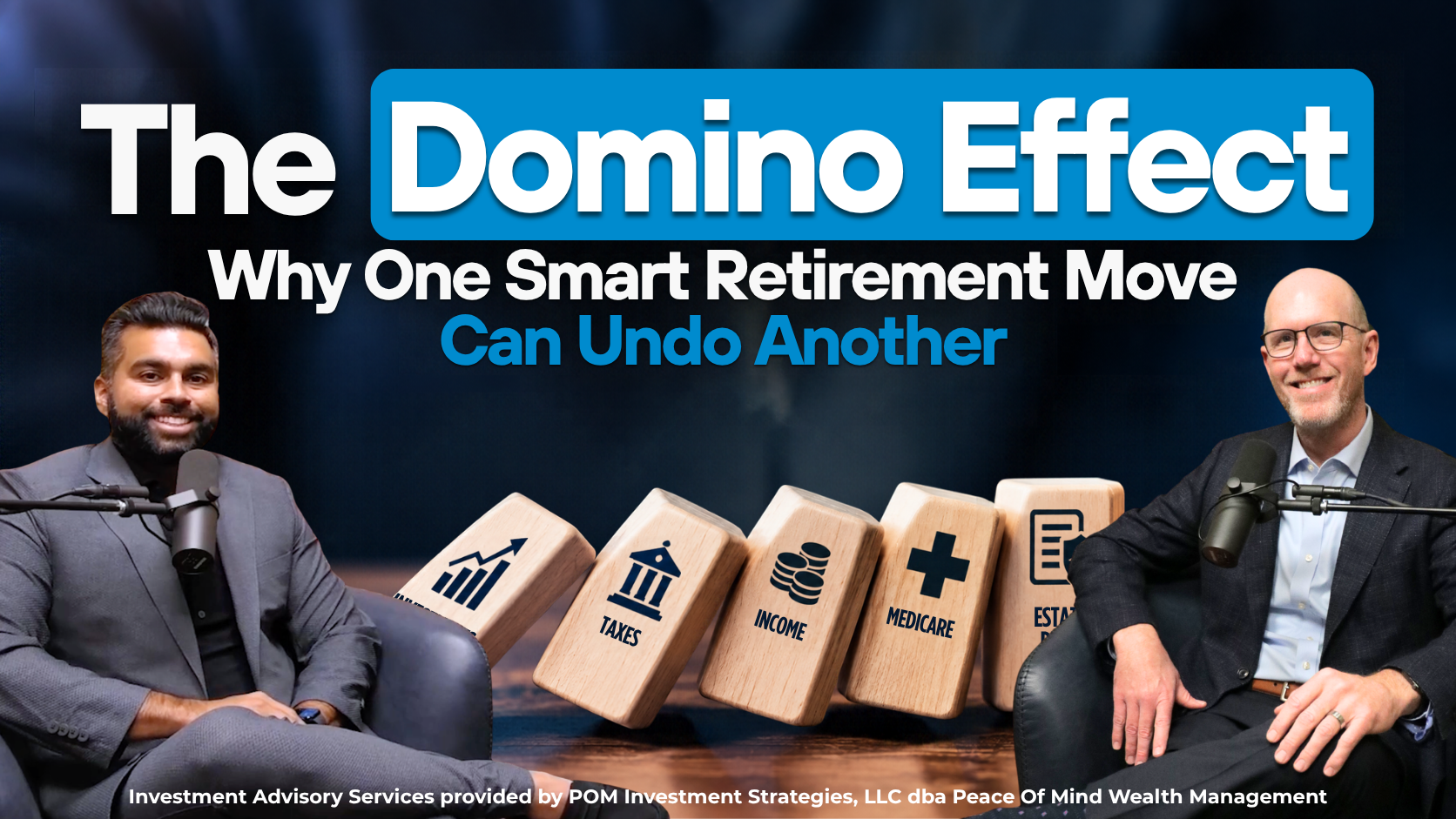
The Domino Effect – Why One Smart Retirement Move Can Undo Another
Most of the people who sit down with us in October and November have done their homework before they walk in. They’ve read about a strategy, run a calculator or asked ChatGPT, and found something that looks like a clean win, like a guaranteed income stream, a stock sale with no capital gains tax, or a Social Security start date a family member swears by. Each of those can be a good decision. The trouble starts when one move lands on another part of the plan and knocks it over, and nobody notices until the tax return comes back in April.
Domino 1: A guaranteed income annuity that cancels a charitable tax break
One client is charitably inclined and already using one of the best tools in retirement tax planning. Each year he takes a $40,000 required minimum distribution from his IRA and sends about $30,000 of it straight to charity as a qualified charitable distribution, or QCD.
Then he found an annuity that would pay him $25,000 a year for life. He didn’t need the income, but the guarantee was hard to pass up, and he told our advisor he’d never seen anything like it.
Every dollar of that annuity income lands on the tax return. So the $30,000 he kept off his taxable income through the QCD would be met with $25,000 of new taxable income he didn’t plan to spend. Most of the charitable tax benefit would disappear, and he’d be paying tax on money that would sit in a checking account.
Our advisor asked what the guarantee was for, and the answer turned out to be safety. He wanted protection if the market dropped and a steady way to grow the money. So we looked at an annuity without the lifetime income feature, one built for downside protection where he decides when money comes out, if it ever does outside of his RMDs. It also avoids the rider charge that often comes with income guarantees. Same goal, and the QCD keeps doing its job.
What to do with this: before you buy anything that pays income, list every source of taxable income you expect next year and write down what the new product adds to that number.
Domino 2: The zero percent capital gains sale that raised a tax bill
Long-term capital gains have their own tax brackets, and many retirees qualify for the 0% bracket without realizing it. One couple did the math and found they could sell stock with about a $39,000 gain and pay no capital gains tax on it. They were right about the rate.
What they missed is how Social Security taxation works. The IRS decides how much of your benefit is taxable using a formula that counts half your Social Security plus your other income, and that includes capital gains, even gains taxed at 0%. Up to 85% of your benefit can become taxable as that number climbs.
So the $39,000 gain pulled more of their Social Security into the taxable column. The sale itself was tax-free, and their tax bill still went up.
This wasn’t a reason to skip the sale. Selling may still be the right move for them. The point of the meeting was to find the trigger before December 31, so they could decide with the full cost in view instead of finding out on April 15.
What to do with this: run any planned capital gain through a full-year projection that includes your Social Security, and look at your total federal tax, not just the capital gains line.
Domino 3: Roth conversions, Social Security timing and the IRMAA clock
There’s no retirement plan where every goal wins at once, so we ask families to name their dominant driver, the one goal that decides close calls.
For some couples, that driver is the surviving spouse. If one spouse earned more and is older, delaying that spouse’s Social Security can leave the survivor with the largest benefit possible. For other families, the driver is Roth conversion strategies and a tax-free legacy for the kids.
In this case, a client’s brother had been telling him to start Social Security right away. The client also wanted to do Roth conversions. Those two goals pull against each other.
Neither choice is wrong. Some people want the Social Security check now and are fine converting less each year. Many of the good savers we work with care more about the Roth and the legacy, and they’re comfortable waiting. For that group, the Social Security question changes from how to get the biggest check to how Social Security fits around everything else.
What to do with this: write down your dominant driver before you decide on Social Security timing, and let it settle the conflicts.
Domino 4: Exiting a variable annuity during a high-income year
We don’t talk much about variable annuities, except for one use, which is tax deferral on non-IRA money you want to keep invested. The catch is that deferred growth eventually gets taxed.
One high-income client has large deferred compensation payments that put him in the 35% bracket. His variable annuity has grown enough that he wants out. He also wants to do Roth conversions during his “valley years,” the stretch after the deferred compensation ends and before RMDs start at 75, the RMD age for anyone born in 1960 or later.
Surrendering the annuity now would stack its gains on top of the deferred compensation at 35%. So the work is in sequencing, deciding which year the exit happens and what can offset income in the meantime. The tax code rewards certain investments with a large upfront deduction, and we review those only one family at a time because they aren’t right for most people.
What to do with this: map your income year by year from now until RMDs begin, and mark the low-income years before you schedule any big taxable event.
Your year-end tax checklist before December 31
These are the seven items we’re talking through with every family right now.
- Qualified charitable distributions. If you’re 70½ or older with IRA money and you give to charity, a QCD can be one of your best tax moves.
- Roth conversions. These carry a December 31 deadline. Aim to have conversions and QCDs decided by December 1, because custodians like Schwab, Fidelity and Vanguard set their own processing cutoffs.
- Capital gains and tax-loss harvesting. Realizing losses, ideally throughout the year, can offset gains on highly appreciated assets.
- Inherited IRAs. Most beneficiaries now have 10 years to empty an inherited IRA instead of stretching it over a lifetime, which raises the tax impact. Plan the withdrawals every year.
- Annuity renewals. Most annuities work on contract years, so review crediting and earnings at each anniversary.
- Estimated taxes. A big capital gain or a business sale can create a tax bill the IRS expects paid during the year, and waiting until April can bring penalties.
What a tax strategy meeting does
That’s why our advisors sit in these meetings with Taylor Wolverton, CFP®, EA, our Director of Financial Planning and Tax Strategy, and why the same team that builds the plan also files the return. One team, one plan, one fee.